426 cats Spayed and Neutered so far!
Grove Community Cat Coalition

What is TNR?
TNR is short for Trap-Neuter-Return, a process in which community cats are trapped in a live trap (no it does not cause any injury to the cat) before being taken to a veterinary clinic to be spayed or neutered, vaccinated, and treated for any additional wounds or ailments. Once the cat has been vetted, they spend time recovering, before being released back to where they were trapped. TNR is the only humane and effective approach to community cats, or unowned cats who live outdoors.
Scientific studies show that TNR effectively addresses the community cat population by ending the breeding cycle, meaning no new kittens are born to a community cat colony. As sound public policy, TNR addresses community concerns, reduces shelter intake and euthanasia, and reduces calls to animal services, all of which save cats’ lives and taxpayer dollars.
When cats are free from the burdens of mating and reproducing, their relationships improve with the people who live near them (think: no more kittens outdoors or yowling, roaming, fighting, or spraying). Additionally, many diseases associated with reproduction are prevented.
The goal is to upend the relentless, ineffective, and pointless cycle of catching and killing cats in animal shelters that has been standard procedure for decades.
Thousands of communities across the U.S. and around the world have embraced TNR at the grassroots level or as official government policy. In rural and urban settings, cold and warm climates, and everywhere in between, TNR works for cats and communities.
Why TNR works, and removing cats from the area doesn't.
TNR (Trap-Neuter-Return) works better than simply removing cats because when you remove cats from an area, new cats will quickly move in to fill the vacant territory, a phenomenon called the "vacuum effect," while TNR prevents new kittens from being born, effectively stabilizing the population over time by preventing further population growth; essentially, by sterilizing the existing cats, you eliminate the source of new cats entering the area.
Key points about why TNR is more effective:
- Territorial behavior: Feral cats are highly territorial, so when a sterilized cat is returned to their area, they actively defend their territory against newcomers, preventing new cats from establishing themselves.
- Population control: By preventing reproduction, TNR directly addresses the root cause of population growth, leading to a gradual decline in the overall cat population within a colony.
- No replacement cycle: Removing cats creates an open space that is quickly filled by new cats drawn to the available food and shelter, leading to a continuous cycle of removal and replacement.
- Humane approach: TNR is considered a more humane method compared to removing cats, as it allows existing feral cats to live out their lives in their familiar environment.
Volunteer Opportunities
For information on volunteer opportunities, reach out to us by emailing GroveCats@gmail.com .
Why the tipped ear?
Why do we tip the TNR cats' ears?
What is the "tipped ear" on some cats? Many people do not know, so we hope you will pass this along, no matter where you are, as a tool to educate the public.
TNR (trap-neuter-return) uses the surgically tipped ear as a universal symbol telling anyone who sees this, that a feral/community cat has been neutered/spayed. These cats will not be caught again, because they are not a risk to increase the kitten population in their colony.
TNR groups use them with all cats. Many owners with indoor/outdoor cats are also having the tipped ear added to their pets during surgery, so that neighbors and TNR groups are aware, their cat is fixed. The procedure is done under anesthesia, with a licensed veterinarian.
Brilliant ideas that catch on! The "Ear Tip Club" is the best club of all.

Bobcat Fever
What is Bobcat Fever?
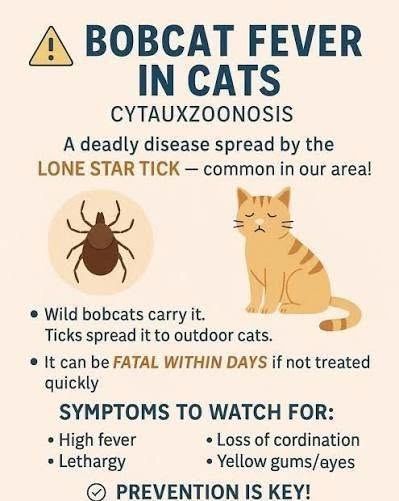
Bobcat fever is a severe, and typically fatal tick-borne disease caused by a microscopic parasite called Cytauxzoon felis. While bobcats are the natural reservoir host and usually carry the parasite without getting sick, domestic and feral cats have no natural immunity to it. The primary carrier and transmitter of the disease is the lone star tick
.
What Does It Do to a Cat?
Once a tick transmits the parasite into a cat's bloodstream, it rapidly multiplies and attacks white blood cells, clogging blood vessels throughout the body.
Rapid Onset: The disease progresses at an alarming speed.
Severe Symptoms: Cats infected with bobcat fever typically experience a sudden high fever, lethargy, severe loss of appetite, dehydration, difficulty breathing, and jaundice (yellowing of the skin and eyes).
High Fatality Rate: Because the disease moves so aggressively, it causes multi-organ failure. Tragically, without immediate, intensive, and extremely costly veterinary intervention, bobcat fever is fatal in the vast majority of cases—often within just a few days of showing symptoms.
Why Is It Such a Huge Risk for Feral Cats?
Community and feral cats face a uniquely high risk from bobcat fever for several critical reasons:
Constant Outdoor Exposure: Because outdoor cats live in the elements, they are in direct and continuous contact with tick habitats like tall grass, brush, and wooded areas.
Difficulty in Prevention: Unlike indoor pets who can easily be kept on monthly oral or topical preventive medications, applying and maintaining consistent flea and tick preventatives for free-roaming community cats is a massive logistical challenge.
Hidden Illness: Feral cats instinctively hide signs of weakness or illness to protect themselves from predators. By the time a community cat slows down enough for a caregiver to notice something is wrong, bobcat fever has often already reached an advanced, irreversible stage.